Skip to Content

Ecology Units 
& Commercial Kitchen Exhaust Systems

Our integrated Ecology Unit & Commercial Kitchen Exhaust solutions combine advanced filtration technologies, precision ventilation engineering, odour control systems, and customized exhaust infrastructure to deliver cleaner air, safer operations, improved environmental performance, and reliable long-term ventilation solutions for restaurants, hotels, hospitals, commercial kitchens, catering facilities, food-service establishments, and industrial applications.

Advanced Kitchen Exhaust Filtration & Air Quality Solutions

FNERZ Group provides engineered ecology units and commercial kitchen exhaust ventilation systems designed to effectively control oil, grease, smoke, particulates, and cooking odors generated by commercial and industrial kitchen operations.

Our solutions combine advanced filtration, odor-control technologies, efficient fan systems, intelligent controls, and application-specific configurations to provide cleaner exhaust air, improved indoor and outdoor air quality, reduced fire risks, and reliable long-term system performance.

Ecology systems are particularly suited for restaurants, hotels, hospitals, healthcare facilities, food courts, commercial kitchens, catering facilities, institutional kitchens, and other high-intensity cooking environments.


Why Ecology Units?

Ecology Units are advanced kitchen exhaust air-treatment systems designed to effectively capture and treat oil, grease, smoke, fine particulates, moisture, and cooking odors before exhaust air is discharged into the environment. They help maintain cleaner air, reduce fire risks, protect ventilation equipment, and improve overall kitchen safety and hygiene.

FNERZ Ecology Units incorporate multi-stage filtration technologies, including UL 900-certified pre-filters and bag filters, activated carbon filtration, and UL 867-certified electrostatic precipitators (ESP), providing efficient particulate, grease, smoke, and odor control.

Engineered for optimum airflow and filtration performance, the systems are selected based on air volume, contaminant load, face velocity, filtration efficiency, and pressure drop. This helps minimize energy consumption, reduce maintenance requirements, protect exhaust fans and ductwork, and extend equipment service life.

Key Benefits

  • Effective removal of oil, grease, smoke, and fine particulates
  • Improved cooking odor control and exhaust air quality
  • Reduced grease accumulation and fire risk
  • Protection of fans, filters, and exhaust ductwork
  • Reduced cleaning and maintenance requirements
  • Improved ventilation and filtration efficiency
  • Lower pressure drop and optimized energy consumption
  • Extended service life of ventilation equipment
  • Reduced operating and maintenance costs
  • Safer, cleaner, and more comfortable kitchen environments

FNERZ Ecology Units provide reliable and sustainable exhaust treatment solutions for restaurants, hotels, hospitals, commercial kitchens, catering facilities, food-production areas, and other high-demand cooking environments.

Commercial Kitchen Exhaust System

Challenges of Traditional Kitchen Ventilation Systems 

Effective removal of oil, grease, smoke, and cooking odors is essential for safe, efficient, and hygienic commercial kitchen operations. Traditional ventilation systems without adequate filtration and exhaust treatment can result in several operational and safety challenges:

  1. Increased Fire Risk – Grease accumulation within exhaust ducts can create significant fire hazards, particularly when exposed to high temperatures and ignition sources.
  2. Higher Maintenance Costs – Continuous buildup of grease and contaminants requires frequent duct, fan, and filter cleaning, increasing maintenance time and operating costs.
  3. Unpleasant Odors – Untreated cooking fumes and grease-laden exhaust can cause persistent odors around kitchens, dining areas, and surrounding premises.
  4. Exhaust Fan Damage – Grease and particulate accumulation on fan blades and motor components can reduce airflow efficiency, increase mechanical wear, and potentially lead to premature equipment failure.
  5. Reduced Ventilation Efficiency – Contaminated filters, ductwork, and fans can restrict airflow and increase system pressure, reducing overall ventilation performance and increasing energy consumption.
  6. Poor Air Quality – Uncontrolled smoke, fine particulates, and odors can negatively affect indoor and surrounding outdoor air quality, creating an uncomfortable environment for occupants and nearby areas. 


Engineered Filtration Technology


FNERZ ecology units can incorporate multiple filtration and odor-control stages according to the application, cooking intensity, exhaust characteristics, and project requirements. 

Additional technologies such as UV filtration, odor-neutralizing systems, ozone treatment, and specialized carbon filtration may be incorporated where required.

The final configuration is selected according to the actual application and cooking intensity.

Typical Filtration Stages

Stage 1


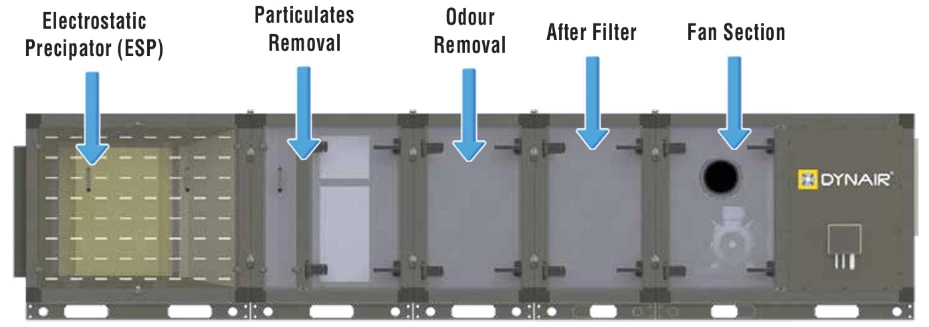
Electrostatic Precipitator (ESP)

An Electrostatic Precipitator (ESP) operates on the principle of ionization and electrostatic collection to effectively remove airborne contaminants such as oil, grease, and smoke from exhaust air.

Air is drawn through the ESP by a motor/blower and passes through a filter bank that captures larger dust particles. Smaller particles, including particles as fine as 0.01 microns, then enter a high-voltage electrical field within the ionizing section, where they receive an electrical charge.

The charged particles subsequently move into the collection section, where a series of alternating charged and grounded plates attract and collect the contaminants. Plates with the same charge repel the particles, while grounded plates attract and retain them on their surfaces.

This process provides highly effective removal of oil, grease, smoke, and fine particulate matter, helping to deliver cleaner exhaust air and improve overall air quality. 


Technical Specifications

  1. Certificate: UL 867
  2. Efficiency: 95% Single Pass & 99% Double Pass ESP 


*Optional Self-Cleaning Auto-Wash Module

The ESP Auto-Wash Module provides efficient and automated cleaning of the collection plates. The system incorporates a built-in heater, pump, solenoid valve, 20L water tank, and rotating spray nozzles for effective cleaning.

Controlled through a PLC-based system, the Auto-Wash Module provides consistent and reliable cleaning performance. Cleaning cycles can be scheduled through the Ecology Unit's control system, ensuring timely maintenance, reducing manual intervention, and maintaining optimum ESP performance.

Stage 2


Pre-Filter

Any residual grease particles that may pass through the ESP stage are captured by the pre-filter, further improving exhaust air quality. The filter effectively traps remaining contaminants while being easy to clean, maintain, and reuse, providing a practical and cost-effective filtration solution.

Typical Specifications
Classification:
EN 779: G2/G4
Certification: UL 900
MERV Rating (ASHRAE 52.2): MERV 4/8 

Stage 3


Synthetic Bag Filter

Before the air reaches the carbon filtration stage, moisture and water vapor are removed by the Bag Filter, which is constructed from high-performance synthetic media. The filter effectively captures moisture and fine contaminants, helping improve air quality and protect the downstream carbon filtration stage for enhanced overall filtration performance.

Typical Specifications
Classification:
EN 779: F7/F9
Certification: UL 900
MERV Rating (ASHRAE 52.2): MERV 13/15 

Stage 4


Hepa Filter (Optional)

HEPA filters are recommended for cleanrooms and Ecology systems where treated exhaust air is discharged toward sensitive or controlled areas, providing enhanced filtration and improved air quality.

However, HEPA filters are generally not recommended for heavy grease applications due to their construction and relatively high pressure drop, which can result in increased maintenance requirements, energy consumption, and operating costs.

Typical Specifications
Certification:
UL 900
Classification: EN 1822: H13/H14 

Stage 5


Odour Treatment

The Odour Control Section in a commercial kitchen exhaust system plays a vital role in controlling cooking odors and other airborne contaminants that may affect the surrounding environment and occupant comfort, particularly in densely populated or enclosed communities. By effectively treating and neutralizing odors before exhaust air is discharged, the system helps improve overall air quality and minimize nuisance odors.

Different odour treatment technologies can be selected based on project requirements, application, and exhaust conditions, including:

  • Activated Carbon Filtration
  • Odour Neutralizers
  • UV Light Treatment
  • Ozone Generators

Optionals


Carbon Filter

Activated carbon filters effectively control and neutralize odour-causing molecules through adsorption, helping maintain a cleaner and fresher environment. Carbon filters are available in various configurations, capacities, and sizes to suit different applications and exhaust conditions, ensuring effective odour control based on project requirements.


Optional Odour Neutralizers / Spray Systems

Odour Neutralizer systems generate a fine atomized mist that is distributed through strategically positioned nozzles within the exhaust stack. The mist interacts with odour-causing compounds and helps neutralize them before they are discharged, providing effective odour reduction and improved exhaust air quality.


Optional UV Filtration

UV filtration provides an additional odour-control solution for commercial kitchen exhaust systems. UV light helps break down odour-causing molecules and organic contaminants within the exhaust airflow, supporting a cleaner, fresher, and more hygienic kitchen environment.


Construction

The Ecology Unit features a robust Pentapost design with reinforced three-way angle joints, forming a rigid and durable frame structure. The framework is constructed using externally mounted aluminium profiles for enhanced strength and durability.

The units are available with double-skin construction, including Rockwool insulation, with various casing thickness options to meet specific project requirements and performance standards.
closeup photo of bonfire

Accessories Includes:

  • Control Panel
  • Differential Pressure Monitoring – DP switches, pressure transmitters, and Magnehelic gauges
  • Fusible Link Fire Damper
  • Fire Suppression System
  • Fire Stat
  • Anti-Vibration Supports
  • Inverter Speed Controllers
  • Weatherproof Canopy

Fan Section

The DEV Series is equipped with a standard DIDW fan, while SISW or fire-rated fans rated up to 400°C for 2 hours can be provided based on project requirements and specifications.

Key Features

  • AMCA-certified fan for air performance and sound levels.
  • PPGI casing suitable for outdoor installation.
  • Backward-inclined impellers manufactured from cold-rolled sheet steel with a durable polyester powder-coated finish.
  • Impellers are statically and dynamically balanced in accordance with AMCA 21940.
  • Fan and motor assembly mounted on a common base frame for improved stability.
  • Assembly isolated from the main structure using anti-vibration mounts to minimize vibration and noise transmission.
  • Flexible joints at the fan inlet and outlet available as an optional feature.

One Size Doesn’t Fit All


Ecology Unit design and selection depend on the type and intensity of cooking, as different kitchen applications generate varying levels of grease, smoke, particulates, and odours. Heavy-duty kitchens involved in grilling, frying, and high-temperature cooking require more advanced filtration and treatment compared to low-intensity kitchens with minimal grease emissions.


Remark: The below configurations are provided for general reference and understanding. Actual system configuration may vary depending on the application, cooking process, exhaust conditions, contaminant load, and intensity of cooking. Each Ecology Unit should be appropriately selected and configured based on the specific project requirements.

Low-Duty Kitchen Configuration


Electrostatic precipitator + Aluminum Pre filter grade (G2) + Synthetic Bag filter grade (F9) + Granulate carbon filter + DIDW fan


Suitable for applications with relatively low levels of grease, smoke, and odor generation.

Typical applications may include:

  • Light commercial kitchens
  • Small restaurants
  • Cafeterias
  • Institutional kitchens
  • Low-intensity food preparation areas

Medium-Duty Kitchen Configuration


Electrostatic precipitator + Aluminum Pre filter grade (G2) + Synthetic Bag filter grade (F9) + Canister Carbon Filter + DIDW fan


Suitable for kitchens producing moderate levels of grease, smoke, and cooking odors.

Typical applications may include:

  • Restaurants
  • Hotels
  • Food courts
  • Catering kitchens
  • Medium-scale commercial kitchens

Heavy-Duty Kitchen Configuration


Double pass electrostatic precipitator + Aluminium Pre filter grade (G2) + Synthetic Bag filter grade (F9) + UV light + Canister Carbon Filter + DIDW fan

Designed for high-intensity cooking environments with greater grease, smoke, particulate, and odor loads.

Typical applications may include:

  • Heavy commercial kitchens
  • Grill restaurants
  • Fried-food operations
  • Large hotel kitchens
  • Central production kitchens
  • High-volume catering facilities
• Design 
• Supply 
• Installation 
• Commissioning & Maintenance

FNERZ provides complete project lifecycle support for Ecology Units and Commercial Kitchen Exhaust Systems, from initial engineering and equipment selection through installation, commissioning, and ongoing maintenance.

Design & Engineering

  • Site assessment and application review
  • Airflow and pressure-drop calculations
  • Equipment and filtration selection
  • Fan selection
  • Control philosophy and system design
  • BMS coordination

Supply & Installation

  • Ecology units and ESP systems
  • Filters, carbon and UV systems
  • Exhaust fans and control panels
  • Equipment and duct connections
  • Electrical and control wiring
  • BMS interface
  • Vibration isolation and accessories

Testing & Commissioning

  • Airflow and static pressure verification
  • Fan performance checks
  • ESP and filtration system testing
  • Filter monitoring
  • Control and alarm testing
  • BMS communication testing
  • System performance verification

Maintenance & Performance

  • Preventive maintenance
  • Filter and carbon replacement
  • ESP cleaning and inspection
  • Fan and motor inspection
  • Electrical and control-system checks
  • UV system maintenance
  • Performance assessment and optimization


Engineered for Cleaner Kitchen Exhaust 

FNERZ Group is committed to delivering advanced kitchen exhaust filtration, odour control, and ventilation solutions that combine engineering excellence, innovative technology, and operational reliability. From high-efficiency electrostatic precipitators and multi-stage filtration systems to odour treatment and engineered exhaust solutions, we provide systems designed to deliver cleaner air, safer kitchen operations, improved energy efficiency, and long-term performance. From initial design and filtration to airflow control and final discharge, FNERZ Group delivers integrated engineering solutions for commercial kitchens, hospitality, healthcare, food service, and other high-performance environments.